
Introduction
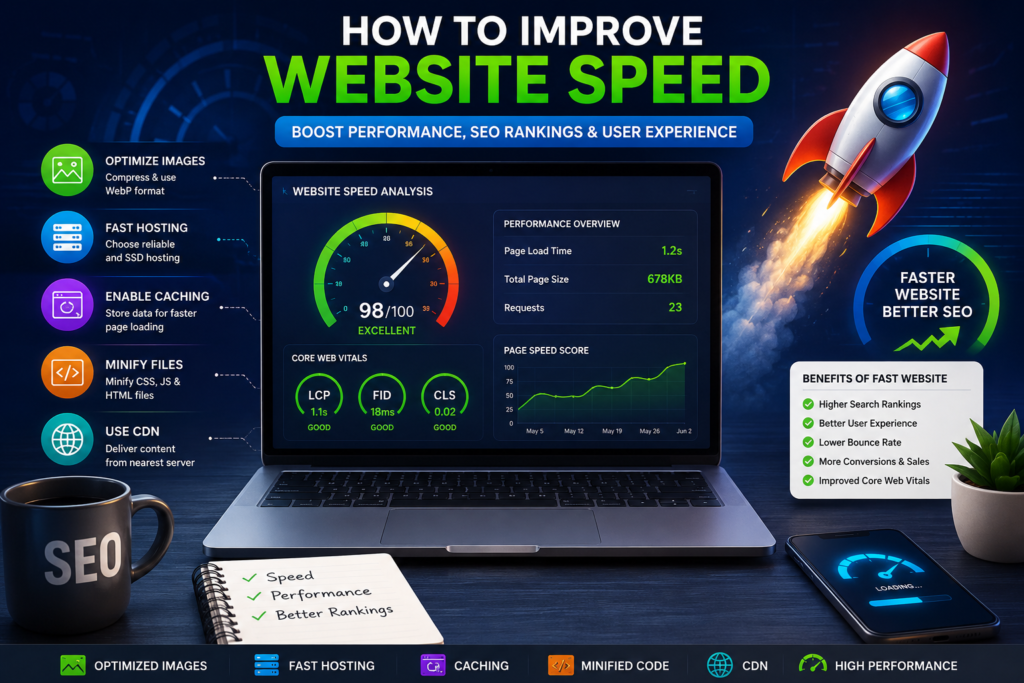
How to Improve Website Speed is one of the most important topics for website owners, bloggers, and businesses. A fast website improves user experience, increases conversions, and helps improve search engine rankings.
Website speed is a key ranking factor in Google’s algorithm. Websites that load quickly perform better in search results, especially on mobile devices where most users browse the internet.
In this guide, you will learn how to improve website speed, how to test performance, and how to apply proven optimization techniques to make your website faster, smoother, and more efficient.
Table of Contents
What Is Website Speed?
Website speed refers to how quickly a webpage loads and becomes usable for visitors. It includes how fast images load, how quickly scripts run, and how responsive the page is when users interact with it.
There are two main types of website speed:
- Page Speed: The loading speed of a single webpage
- Site Speed: The overall performance of an entire website
A well-optimized website typically loads in 2 to 3 seconds. Anything slower can negatively affect user experience and SEO performance.
Why Website Speed Matters
Understanding how to improve website speed is important because speed directly impacts your online success.
Better User Experience
Fast websites allow users to navigate smoothly without waiting for pages to load.
Improved SEO Rankings
Google uses website speed as a ranking factor, so faster sites often rank higher.
Lower Bounce Rate
Slow websites cause visitors to leave quickly, increasing bounce rates.
Higher Conversions
Faster loading pages improve trust and increase sales or sign-ups.
Better Mobile Experience
Most users browse on mobile devices, so speed optimization is critical for mobile traffic.
How to Test Website Speed
Before learning how to improve website speed, you need to analyze your current performance using reliable tools.
Google PageSpeed Insights
A free tool by Google that analyzes website speed and Core Web Vitals performance.
GTmetrix
Provides detailed insights about loading time, page size, and performance issues.
Pingdom Tools
Helps test website speed from multiple global locations to check real-world performance.
Best Ways to Improve Website Speed
Here are the most effective techniques for how to improve website speed:
Optimize Images
Compress images before uploading and use modern formats like WebP for faster loading.
Use Fast Web Hosting
Good hosting reduces server response time and improves overall performance.
Enable Browser Caching
Caching stores website files on the user’s device for faster repeat visits.
Minify CSS, HTML, and JavaScript
Removing unnecessary spaces and code reduces file size and improves speed.
Use a Content Delivery Network (CDN)
A CDN distributes your content across multiple servers worldwide for faster access.
Reduce Unnecessary Plugins
Too many plugins can slow down your website and increase load time.
Enable Lazy Loading
Images and videos load only when users scroll to them, improving initial speed.
Enable GZIP Compression
This reduces file size before sending it to the browser.
Mobile Optimization
Mobile optimization is a major part of how to improve website speed because most users access websites through smartphones.
- Use responsive design for all devices
- Compress images for mobile users
- Reduce popups and heavy scripts
- Avoid unnecessary animations
A mobile-friendly fast website performs much better in search rankings.
Common Mistakes That Slow Down Websites
Many website owners unintentionally reduce performance. Avoid these mistakes:
- Uploading large uncompressed images
- Using low-quality hosting
- Installing too many plugins
- Ignoring mobile optimization
- Using heavy scripts and animations
Fixing these issues can instantly improve website performance.
SEO Benefits of Website Speed
Website speed plays a direct role in SEO success:
- Faster indexing by Google bots
- Better Core Web Vitals scores
- Higher search rankings
- Lower bounce rate and better engagement
Fast websites consistently outperform slow competitors in search results.
Conclusion
Learning how to improve website speed is essential for SEO success, better user experience, and higher conversions. A fast website keeps visitors engaged, improves rankings, and increases trust.
By optimizing images, using caching, choosing better hosting, and reducing unnecessary code, you can significantly improve your website performance.
Website speed optimization is not a one-time task—it is an ongoing process. Regular testing and improvements will ensure your website stays fast, competitive, and user-friendly.